01
Time
2023 - 2025
Team
Studiokurbos
Design system migration and rebuild for a series-production HMI. Two in-car displays, five premium vehicle models, moved from years of legacy design files into a structured Figma system. Built in continuous collaboration with the client's design department and engineering teams across time zones.
A note on visuals. This project is under NDA. All interface visuals in this case study are recreations built specifically for this portfolio: generic layouts, fictional data, no client design language. They illustrate the type of work and the thinking behind it, not the delivered product.
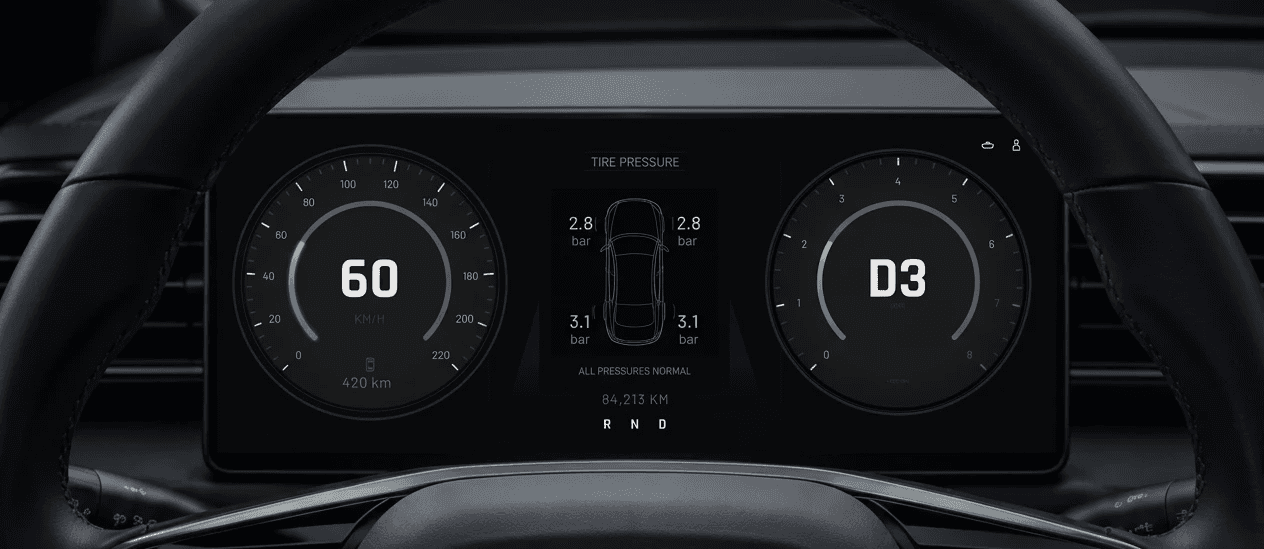
Visuals shown are anonymized recreations for illustration purposes; actual production interfaces are under NDA.
01
The HMI had been evolving for many years, across generations of tools and designers. The result was a set of design files that disagreed with themselves. The same spacing existed in three slightly different versions. Elements sat off the pixel grid. Colors and type styles had accumulated near-duplicates, and much of the actual interaction logic was never documented.
Our task was to migrate all of it into Figma as a single source of truth. On paper that sounds mechanical: redraw everything. In practice it is impossible to faithfully redraw an inconsistent system. Every inconsistency forces a decision about what the correct version should be.
02
Whenever legacy files contradicted each other, someone had to establish the canonical version. That meant comparing files from different generations, checking how the real system behaved on the actual displays, and confirming undocumented details with engineers and the client's design team.
Each decision on its own was small. A spacing value, an alignment rule, which of five nearly identical grays survives. Together they defined the quality of the entire system. This is where I spent much of the project, and where I learned that consistency is built decision by decision.
03
Screens were reconstructed from components with variants, so that one master component could serve different states, screen sizes, and vehicle models. Typography and color moved into managed styles and tokens, replacing the accumulated near-duplicates with a single defined palette.
The payoff of this structure is leverage. A correction made once propagates everywhere it is used. Across two displays and five vehicle models, that is the difference between maintaining a system and endlessly patching files.
04
The system was not frozen while we rebuilt it. The client's internal design department kept iterating, and every decision they made had to be reflected in our Figma system at pixel-level accuracy, quickly, without introducing new inconsistencies.
This rhythm shaped how I work. I learned to read design intent precisely from another team's decisions, to translate it into the system's logic instead of pasting it in, and to keep quality stable under production deadlines in a distributed, Scrum-based setup.

05
The most valuable outcome of this project wasn't the number of screens delivered — it was judgment: how to make sound decisions within complex constraints, collaborate precisely with distributed engineering teams, and communicate design intent so that it survives implementation.
That discipline isn't specific to automotive. It's what any complex, high-stakes product demands — whether the system lives in a vehicle, a hospital, or an enterprise workflow.

